




Guide to selecting materials for preparing a sterile field
NWF and laminated materials: Spunbond, Spunlace, SMS, bilaminate or trilaminate?
Correct preparation of the sterile field is not solely dependent on the techniques used for apparel and draping. The choice of materials used for drapes and gowns also plays a crucial role in preventing contamination and protecting patients, operators, and surfaces during surgical procedures.
Spunbond, SMS, Spunlace, bilaminate, and trilaminate fabrics have different characteristics. Some materials prioritise lightness, comfort and breathability, whilst others enhance barrier properties or the ability to absorb and retain irrigation solutions.
No single material is universally better than any other. Selecting the right material should always take into account the duration of the procedure, the expected amount of fluids, the area to be protected, and the level of barrier required.
Whether you are performing a thorough clean, or a lengthy advanced implantology procedure, this guide will help you understand the different solutions available, and the factors to consider when making your choice.
Materials for the sterile field: two main categories
To navigate between the different solutions, it is useful to start by distinguishing two main categories:
- the Non-Woven Fabrics (NWF), including Spunbond, SMS and Spunlace;
- the laminated materials, produced by joining two or more layers with complementary functions.
Remember: the number of layers alone does not determine the quality or safety of a material. It is the structure, overall performance and intended use of the finished product that make it suitable for a specific clinical application.
The EN 13795-1 standard defines requirements and test methods for surgical gowns and drapes, evaluating characteristics such as: resistance to liquid penetration, mechanical resistance in both dry and wet states, microbial cleanliness, particle shedding, and resistance to microbial penetration.
It is also important to clarify another key aspect: no material is sterile by its very nature. When we talk about sterile fabric, we are referring to a finished product that has undergone a validated sterilization process and has been stored in unopened packaging until it is used.
NWF: characteristics and differences between Spunbond, SMS and Spunlace
NWF (non-woven fabric) is a technical material obtained by the mechanical, thermal, or chemical bonding of fibres, without using traditional weaving methods.
Spunbond, SMS and Spunlace all belong to the category of non-woven fabrics, but they are produced using different processes and provide specific performance properties.
Spunbond
Spunbond is an NWF generally made from continuous filaments of thermoplastic material, such as polypropylene. The filaments are arranged uniformly and bonded together, often using a thermal process.
This structure results in a lightweight, flexible and breathable material with good mechanical resistance. This means that Spunbond is particularly suitable for disposable gowns and protective clothing intended for routine outpatient care or short procedures, where exposure to liquids is limited.
Key advantages
- Lightness and comfort;
- Breathability;
- Good fit.
SMS
SMS (Spunbond – Meltblown – Spunbond) is also a non-woven fabric, consisting of three layers:
- two layers of Spunbond, made from stronger fibres, which ensure resilience;
- a central layer of Meltblown material, composed of thin fibres, which increase the barrier performance against fluids and particles.
This combination results in a material that is lightweight, water-repellent, durable, and breathable. This makes SMS particularly suitable for surgical gowns, especially during procedures of medium duration.
Key advantages
- Good balance between barrier and breathability;
- Lightness and comfort;
- Tear resistance;
- Freedom of movement.
Spunlace
Spunlace is a non-woven fabric (NWF) in which the fibres are bonded and interwoven by means of high-pressure water jets, without the use of traditional weaving. This process results in a soft, flexible, and durable structure.
Spunlace is particularly suitable for gowns intended for long-duration surgical procedures and for procedures that require a high level of comfort and protection.
Key advantages
- Softness and comfort;
- High breathability;
- Good mechanical resistance;
- Good fit;
- Ideal for longer procedures, depending on the performance level of the product.
Read this in-depth article on NWF
Laminated materials: synergistic absorbency and water resistance
In laminated materials, two or more layers are bonded together to combine functions that may not be possible for a single material to provide.
Bilaminate materials
Bilaminate material is created by joining two layers, which are generally:
- an absorbent top layer, made of NWF or cellulose;
- a waterproof bottom layer, generally made of polyethylene.
This dual function makes it particularly suitable for the production of surgical drapes, because it allows irrigation solutions to be absorbed, while simultaneously preventing them from passing through to the patient or the surfaces beneath.
Key advantages
- Absorbent on the upper side;
- Waterproof on the lower side;
- Effective protection for surfaces and patients;
- Available in different shapes and sizes.
Trilaminate materials
The term trilaminate refers to a material composed of three elements bonded together. The composition may vary, but it generally includes:
- an absorbent layer;
- a waterproof membrane;
- a supporting or protective layer.
Depending on their composition, trilaminate materials can be used for drapes and gowns intended for complex procedures, operations with a longer duration, or procedures involving significant exposure to liquids.
Key advantages
- Ability to combining absorbency and durability;
- Greater control of fluids;
- Good performance during longer procedures.
Comparative table of materials
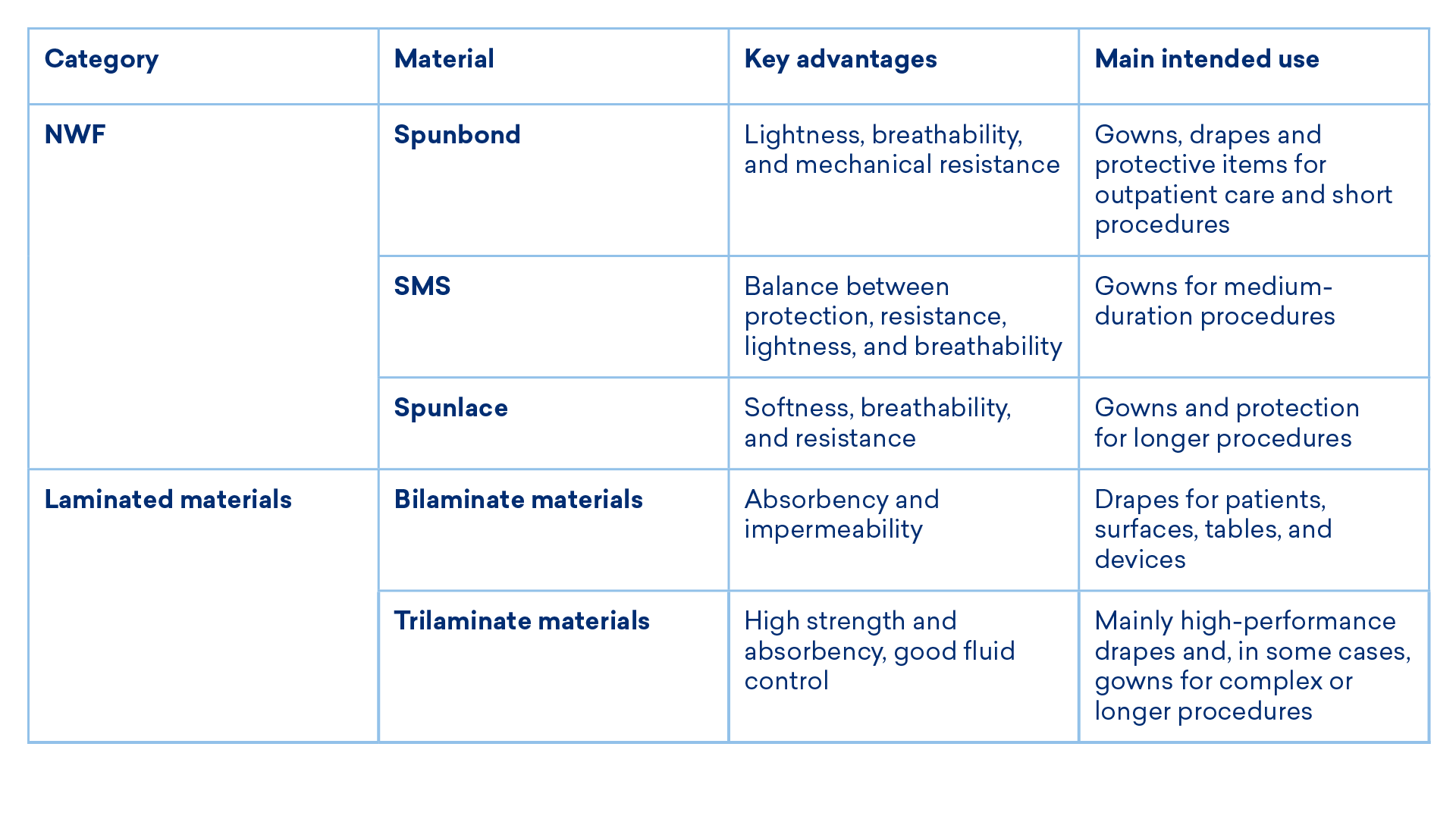
Selection guide: which material for which procedure?
As has already been mentioned, when choosing the most effective solution, it is necessary to consider the requirements of the procedure, not just the material or the weight. For procedures with longer durations or higher complexity, it may be necessary to use multilayer materials or solutions capable of delivering high performance.
Short procedures involving limited exposure to fluids
For shorter procedures and outpatient care, during which the use of irrigation fluids and the risk of splashes are limited, a lightweight and breathable material may be sufficient. A suitable configuration may include:
- NWF Spunbond gowns;
- bilaminate sheets to protect the patient and surfaces
- disposable protection for high-risk areas and devices.
Medium-duration procedures with moderate exposure to liquids
Routine implantology and periodontology procedures require more comprehensive protection. An effective configuration may include:
- sterile SMS gowns;
- absorbent and waterproof bilaminate drapes;
- adhesive drapes to delimit the surgical area;
- sterile protection for handpieces, tubes, and components of the dental chair.
Complex, long procedures with high exposure to liquids
Advanced implantology procedures, regenerative surgery, or maxillofacial surgery may require longer operating times, numerous sterile components, and significant amounts of saline solution. It is therefore recommended to choose:
- high-performance sterile gowns, such as those made of NWF Spunlace;
- large, absorbent, and waterproof drapes;
- adhesive openings that maintain the boundaries of the surgical field;
- protection designed for the equipment;
- systems for the management and collection of liquids.
A specific fabric for every user
The choice of gown can also be tailored to the wearer, always taking into account what they have to do, the duration of the procedure, and the expected level of exposure to liquids.
For patients, a light Spunbond gown may be suitable, which prioritises coverage and comfort.
For surgical assistants, in routine surgical procedures and when working close to the sterile field, SMS microfibre offers a good balance between barrier protection, strength, and breathability; during shorter procedures involving limited exposure to fluids, a lighter NWF may be suitable.
For surgeons, SMS is a versatile solution for routine procedures, while for longer or complex procedures, Spunlace can provide greater softness, a better fit, and more comfort during prolonged use. When the surgical assistant also needs to work in the sterile field, or is subject to exposure comparable to that of the operator, it is advisable to provide an equivalent level of protection for both.
These combinations are intended as guidelines, not strict rules. Ultimately, the choice should be based on the activity being performed, the duration of the procedure, the expected volume of fluids, and the documented barrier performance of the finished gown.
Checklist for choosing the most suitable material
Before preparing the materials for the sterile field, it is useful to ask yourself:
- How long is the procedure expected to last?
- What level of exposure to fluids will there be?
- Which areas of the patient, the operator, and the environment need the most protection?
- Does the material need to be absorbent, impermeable, breathable, or a combination of these properties?
- Does the shape of the drape provide the correct boundary for the surgical area?
The answers to these questions help you to choose not only the material, but the entire protection system to be set up around the patient and the surgical team.
Simplifying your selection: The Euronda Alle Set
In daily practice, the selection and preparation of individual components takes time and increases management complexity. The Euronda Alle sterile sets simplify this task by providing a single pack that combines all the products needed for staff apparel, patient protection, and preparation of the operating area.
The components are organized according to the order in which they are used, which helps to:
- facilitate and speed up the preparation of the sterile field;
- standardize the surgical protocol;
- simplify procurement;
- minimize the risk of oversights;
- reduce the number of packs that need to be opened;
- facilitate the traceability of the equipment used.
In addition to standard configurations for the most common procedures, customizable sets and solutions are available, in which drapes, gowns and protective equipment can be combined according to the type of procedure. In this way, the choice of materials becomes part of an organized, ready-to-use system that is easier to manage.
Discover the Euronda Alle surgical sterile sets.
The right choice stems from the requirements of the procedure
Spunbond, SMS, Spunlace, bilaminate and trilaminate materials are not perfectly interchangeable alternatives. Each material meets different needs and must be evaluated in relation to the procedure, exposure to fluids, and the function of the individual product.
Setting up the sterile field correctly results from the combination of suitable materials, compliant devices, preparation technique, and work organization.
Taking all these factors into account allows you to create a barrier system that is consistent with the requirements of the procedure, and to maintain the effectiveness of this system for the entire duration of the procedure.
Sources
- UNI EN 13795-1, Surgical clothing and drapes – Requirements and test methods – Part 1: surgical drapes and gowns.
- EDANA, in-depth information on non-woven fabrics and on the Spunbond and Meltblown production processes.
- CDC/NIOSH, criteria for the selection of protective clothing and assessment of product design characteristics.
- Euronda Alle Blog – “Surgical drapes and gowns in NWF: materials and standards”
- Euronda Alle Blog – “Role, function and importance in dental practice”
- CDC PPE-Info / AAMI TIR11. Selection and use of protective apparel and surgical drapes in health care facilities.wwwn.cdc
- Midha VK, Dakuri A, Midha V. Studies on the properties of nonwoven surgical gowns. Journal of Industrial Textiles. 2013;43(2):174–190.scribd